
Laser Grid Arrays
A Laser Grid Array is an optical field instrument that splits a concentrated laser diode beam—most commonly a 532nm green or near-infrared wavelength—through a specialized diffraction grating lens to cast a matrix of hundreds of uniform light points across a designated room, corridor, or doorway. By establishing a fixed geometric baseline across walls, furniture, and architectural thresholds, the grid transforms an unstructured three-dimensional space into an active optical measurement field.
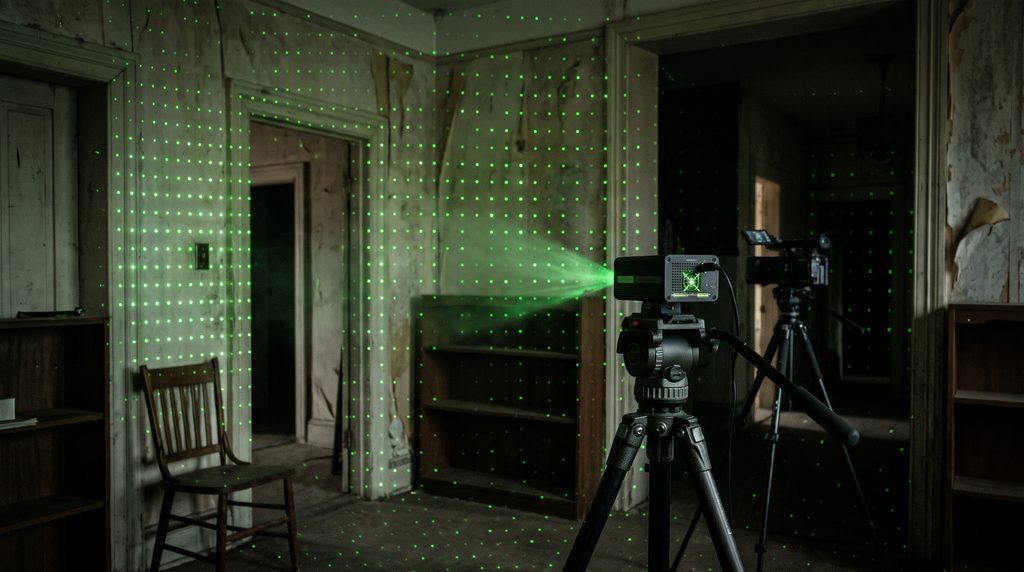
Parapsychological researchers deploy laser grids primarily to capture physical occlusion and dimensional silhouettes during investigations of shadow figures and apparitions. When an anomalous mass passes between the laser emitter and the background surface, it breaks the projected light paths, causing a cluster of laser dots to vanish or warp across the contours of the intruding form. A stationary video camera aligned directly behind or slightly off-axis from the emitter provides continuous frame-by-frame documentation of any spatial occlusion.
Critical debunking protocols are essential when analyzing laser grid footage. Airborne particulates such as dust motes, aerosol vapors, or tiny gnats drifting within millimeters of the diffraction lens can block multiple beam paths simultaneously, projecting an exaggerated, shifting void across distant walls that mimics a large passing shadow. Furthermore, mechanical vibration of the projector mount caused by footsteps or floor settling will cause the entire dot matrix to jitter, requiring heavy, isolated tripod stabilization.
Was this document helpful?
Thank you for your feedback!