
SLS Camera
The SLS Camera (Structured Light Sensor) is an optical field instrument adapted from infrared depth-sensing and machine vision hardware. The device projects a matrix of thousands of invisible infrared speckles across a space, measuring the time-of-flight or triangulation deformation of those points to build a real-time 3D topographical depth map. Computer vision algorithms (such as skeletal tracking and pose estimation) then analyze the scene to identify human-like joint configurations and skeletal anatomy.
In paranormal research, the SLS camera is deployed to detect humanoid figures that remain completely invisible to the naked eye. When the software recognizes appropriate distances between head, torso, and articulating limb joints in an empty area, it overlays a colored wireframe stick figure on the screen. Investigators look for stick figures that walk with anatomically coherent movements, react to verbal prompts, or climb onto furniture.
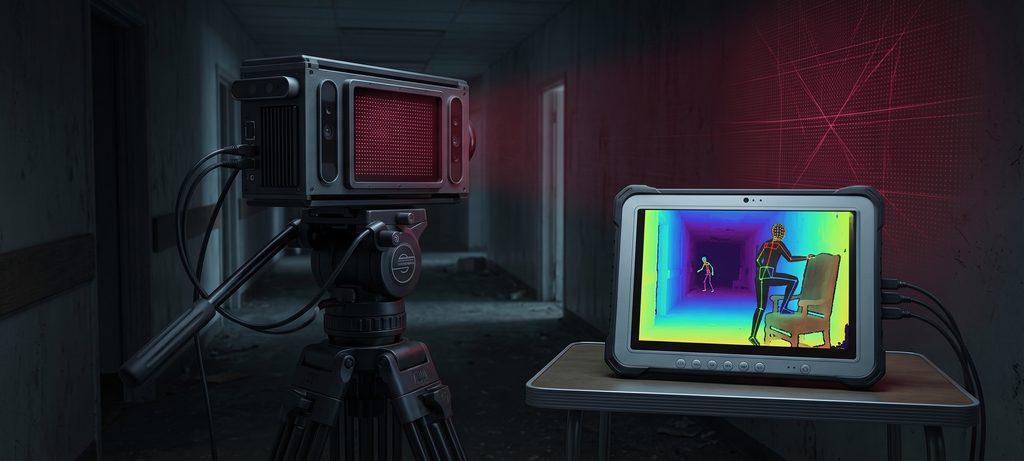
Because the underlying neural models are trained to seek out human shapes, false positives are frequent. The system will aggressively attempt to map stick figures onto door moldings, high-backed chairs, folded coats, and uneven wall trim. Reliable SLS documentation requires mounting the unit on a rock-steady tripod to prevent parallax artifacts, ensuring skeletal figures maintain stable joint geometry over multiple consecutive seconds rather than flashing in and out as single-frame glitches.
Was this document helpful?
Thank you for your feedback!