
Faraday Shielding in Investigations
A Faraday Cage—named after English scientist Michael Faraday who established the concept in 1836—is an enclosure formed by conductive metal materials such as copper mesh, aluminum, or specialized silver-plated radio frequency (RF) shielding textiles. The physical principle relies on electrostatic induction: when an external electromagnetic field or radio frequency wave strikes the conductive boundary, the electrical charges within the conductor redistribute, effectively canceling out the field within the interior of the enclosure.
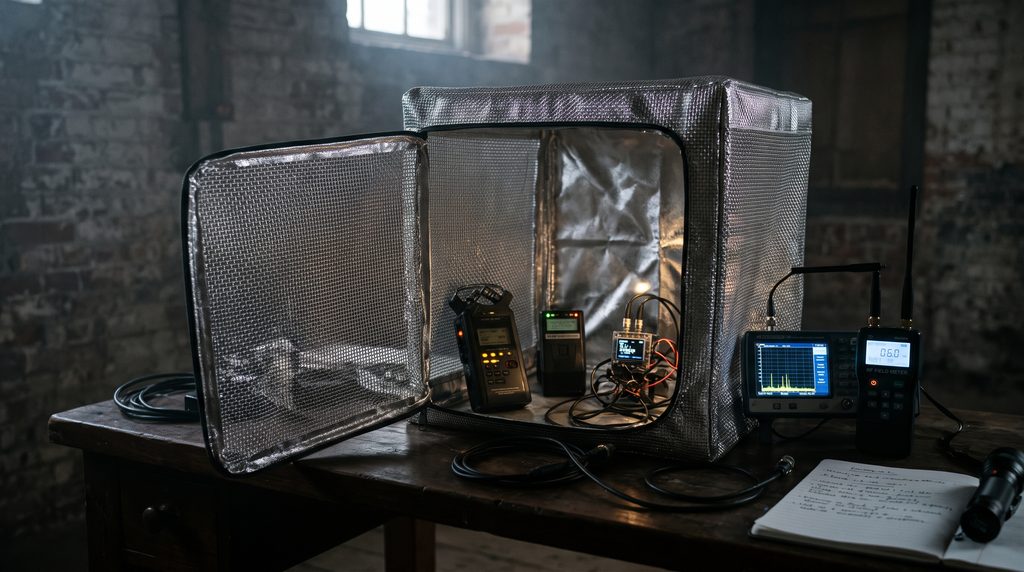
In modern paranormal investigation and Instrumental Transcommunication (ITC) research, Faraday shielding provides an essential experimental control. A frequent critique of Spirit Box sessions, EVP recordings, and high-frequency communication experiments is the intrusion of stray broadcast radio signals, cellular handset data handshakes, emergency dispatch transmissions, and localized Wi-Fi beacons. Placing audio recorders, RF sensors, or experimental ITC rigs inside a verified RF-shielded Faraday enclosure isolates the equipment from all external ambient broadcast contamination.
Implementing Faraday shielding in the field requires meticulous verification using a wideband spectrum analyzer or RF field meter. Any seams, zipper gaps, unshielded cable pass-throughs, or imperfect seals in the conductive fabric can cause high-frequency microwave leakage, invalidating the test. When an unexplained vocalization, electromagnetic spike, or coherent phrase is captured on a device operating inside a sealed Faraday environment, investigators possess significantly stronger empirical proof that the anomaly did not originate from mundane ambient transmissions.
Was this document helpful?
Thank you for your feedback!