
The Estes Method
The Estes Method is a modern, highly controlled Instrumental Transcommunication (ITC) protocol designed to eliminate the severe observer bias and auditory pareidolia associated with traditional Spirit Box sessions. Developed by paranormal researchers Karl Pfeiffer, Connor Randall, and Michelle Tate in 2016 at the Stanley Hotel in Estes Park, Colorado, the method introduced sensory deprivation into active paranormal communication, fundamentally shifting how field teams conduct real-time audio sessions.
The protocol requires a minimum of two investigators. The first investigator, acting as the “Receiver,” is blindfolded and wears heavy-duty, noise-isolating headphones connected directly to a Spirit Box (a device rapidly sweeping radio frequencies). The Receiver cannot see the room, hear their partner, or understand the context of the investigation. The second investigator, acting as the “Operator,” stands in the room and asks questions out loud to the environment. As the Receiver hears coherent words or phrases emerge from the white noise, they repeat them out loud immediately.
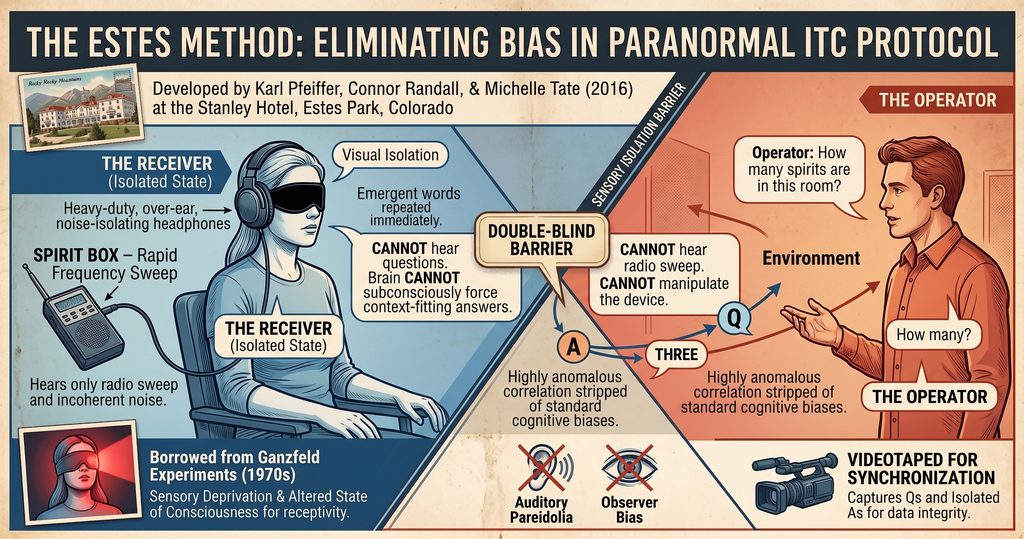
This setup creates a strict double-blind barrier. Because the Receiver cannot hear the questions being asked, their brain cannot subconsciously matrix the static to force an answer that fits the context. Conversely, because the Operator cannot hear the radio sweep, they cannot manipulate the device to find words they want to hear. If the Operator asks, “How many spirits are in this room?” and the deafened Receiver immediately blurts out “Three,” the correlation is considered highly anomalous and stripped of standard cognitive biases.
The Estes Method borrows heavily from the Ganzfeld experiments of the 1970s, which utilized sensory deprivation to test for telepathy. By forcing the brain into a state of sensory starvation, the method encourages a light altered state of consciousness in the Receiver, making them theoretically more receptive to external anomalous input. To ensure data integrity, the entire session must be recorded on video, capturing both the Operator’s questions and the Receiver’s isolated responses for later chronological synchronization.
Was this document helpful?
Thank you for your feedback!